• Skip to primary navigation
  • Skip to main content
  • Skip to primary sidebar
  • Skip to footer

Johns Hopkins Vasculitis Center

Show Search
Hide Search
  • About Our Center
    • Appointments and Directions
    • Meet Our Team
    • Support Our Center
  • What is Vasculitis?
    • Types of Vasculitis
    • Causes of Vasculitis
    • Symptoms of Vasculitis
    • Diagnosing Vasculitis
  • Vasculitis Treatments
    • Prednisone
    • Avacopan (Tavneos®)
    • Apremilast (Otezla®)
    • Azathioprine
    • Colchicine
    • Cyclophosphamide (Cytoxan)
    • Dapsone
    • Supplemental Immunoglobulin (IVIG/SCIG)
    • Leflunomide
    • Mepolizumab (Nucala®)
    • Methotrexate (MTX)
    • Mycophenolate
    • Rituximab
    • Sarilumab (Kevzara®)
    • TNF Inhibitors
    • Tocilizumab (Actemra®)
  • Vasculitis Research
  • Resources
Home / Search for "search.html/whatis/diagnosis.html/page/polyarteritis.html/treatments/cryoglobulinemia.html"

Search Results for: search.html/whatis/diagnosis.html/page/polyarteritis.html/treatments/cryoglobulinemia.html

Resources

Living with vasculitis can be challenging at times due to the complex nature of the disease and therapies. Also, vasculitis in the general population is quite rare, especially compared to other common medical conditions, such as diabetes and hypertension (high blood pressure). This can make patients with vasculitis feel misunderstood or alone. It can be very helpful for individuals with vasculitis to connect with other patients and their families.

If you have vasculitis, you are not alone. There is a strong community of patients and physicians to support you.

  • Vasculitis Foundation (USA) – www.vasculitisfoundation.org
  • Vasculitis UK – www.vasculitis.org.uk/
  • Vasculitis Foundation Canada – www.vasculitis.ca/
  • American Behcet’s Disease Association
  • Churg-Strauss Syndrome Association
  • Cryoglobulinemia Home Page
  • Arthritis Foundation
  • The American College of Rheumatology
  • European Vasculitis Study Group: EUVAS Homepage

Appointments and Directions

For New Patients

In order for your care to be matched to an appointment with an expert in the field of your diagnosis, it is necessary to have your records available to our physician reviewers prior to scheduling an appointment. Therefore, we ask that you have your referral and medical records faxed to 410-367-2371 or emailed to PASOnBaseRheuma@jhmi.edu. It is important to include the following: a referral from your current physician, any clinical notes, imaging reports (including x-rays and MRIs), lab results, other tests results as applicable (such as pulmonary function tests echocardiograms, pathology reports, EMG/NCS results).

Once the review process has been completed, you will be contacted by one of our intake coordinators to assist with scheduling your appointment. You may also call the scheduling office at 443-997-1552 at any time to inquire as to the status of your record review.

For International patients, please contact Johns Hopkins International for initial and return patient appointments.

Unfortunately, our physicians cannot speak with or give medical advice to patients that are not currently under our care.

On the day of your scheduled appointment, it is important to:

  • Arrive at least 30 minutes before your appointment to allow time for registration
  • Bring your insurance card
  • Bring a photo I.D.
  • Bring your co-payment
  • Bring a copy of name and address of all persons/doctors who would like to get copies of your visit materials
  • Bring the following medical records if not already sent:
    • All medical records relevant to your diagnosis (including rheumatology records, discharge summaries)
    • List of all current medications (include all over-the-counter medications)
    • Recent laboratory results
    • Any imaging results (i.e., x-rays, ultrasounds, etc.)
    • Pulmonary function tests (bring all test results)
    • Echocardiogram (bring all test results)

High resolution CT scan of lung (bring written report and copy of actual scan on CD-ROM disc)

Please forward the results of previous medical evaluations. In particular, the following information is required:

  • Referral letter from your physician
  • Summary letter from your doctor and/or hospital discharge summaries
  • Recent laboratory results
  • Biopsy slides or reports
  • Results of radiology studies

This “information gathering” is an important component of your visit. It allows the Vasculitis Center’s physicians to examine and review relevant information before your scheduled visit. This preparation greatly speeds the development of an effective plan for medical care. If time permits, we will send you a questionnaire to fill out before your appointment.

International Patients

For International patients, please contact Johns Hopkins International for initial and return appointments.

For Returning Patients

You will need to plan for a one day visit to the Center as a return patient.

  • Return appointments for the Vasculitis Center can be made by calling 443-997-1552.
  • Please arrive 15 minutes before your appointment.
  • You may also be asked to complete some additional forms to allow us to bill your insurance, to review your health, and let us know how you have been doing since your last visit.
  • Bring a copy of your insurance cards.

Late, Canceled and No Show Appointments

Late: The appointment time scheduled for you is time specifically allotted for your visit. If you are running late for an appointment, please call our scheduling office. Please note if you are more than 15 minutes late for your scheduled appointment time, we may not be able to accommodate your visit.

Canceled / No Show: If you are unable to keep your appointment we require a minimum of 24 hours’ notice. If you repeatedly do not provide our office with 24 hours’ notice, you may be subject to be discharged from our practice.

Rescheduling Appointments

Our clinic is very busy and unfortunately patients often have to wait several months for an appointment. If you need to reschedule your appointment, please call us at 443-997-1552 as soon as possible. This will allow us to schedule another patient who is waiting to be seen.

Office Hours

Our normal clinic hours are Monday – Friday 7:30am-5:00pm. Our normal phone hours are Monday – Friday 9:00 AM -4:00 PM.

Our Office is closed for the following Holidays:

  • New Year’s Eve
  • New Year’s Day
  • Martin Luther King, Jr. Day
  • Memorial Day
  • Independence Day (July 4th when it falls on a regular business day, the Friday before when it falls on Saturday, or the Monday after when it falls on Sunday)
  • Labor Day
  • Thanksgiving Day
  • Day after Thanksgiving
  • Christmas Eve
  • Christmas Day (December 25th when it falls on a regular business day, the Friday before when it falls on Saturday, or the Monday after when it falls on Sunday)

There may be other posted days that are closed due to divisional activities and/or professional development. That information will be provided on all divisional voicemails.

After-Hours, Weekends and Holidays Calls

  • If you are experiencing a medical emergency after-hours, please call 911 or go to your nearest urgent care facility or emergency department.
  • If your need is a medical management question that cannot wait until our next business day, we offer an On-Call Provider to help you. Our On-Call Provider may be paged by calling our answering service at 410-955-6070.

Inclement Weather and Unexpected Closings

  • It is the policy of Johns Hopkins Medicine to reasonably maintain outpatient clinical operations; however, due to weather or other unexpected closings, such as an area-wide power outage or water main break, there may be times when it is necessary to close our office.
  • Our closing notices will be provided for you via our voicemail recording and our staff will contact you if we are not able to keep your appointment, let you know what we are experiencing, and when we may be looking to reschedule your visit.

Insurance / Billing Information

We are participating with the following insurance payors:

  • Aetna Health Plan
  • Beech Street PPO
  • Blue Cross Blue Shield
  • CareFirst BlueChoice HMO
  • CIGNA
  • Coventry Healthcare
  • EHP
  • First Health
  • Great West/One Health PPO
  • Humana Choicecare
  • InforMed/CHP
  • Kaiser
  • MDIPA HMO
  • Maryland Medical Assistance
  • Medicare Part B*
  • Multiplan PPO
  • NCAS
  • One Net PPO
  • Optimum Choice HMO
  • Priority Partners MCO
  • Private Healthcare Systems (PHCS)
  • Tricare Reserve Select
  • Tricare Standard
  • US Family Health Plan

*We do not participate with out-of-state Medicaid or Medicare Advantage/Replacement plans.

Copayments:

It is a good idea to check with your insurance to make sure you are covered for your visit and services with us. Please be prepared to pay your copay and any balance due at the time of your visit. We accept VISA, MASTERCARD, DISCOVER, AMERICAN EXPRESS, and E-CHECKS.

Non participating insurance/self-pay:

We realize that insurance may not always cover care at Johns Hopkins. With the exception of Medicare Advantage and Medicaid plans, patients may have the ability to pay out-of-pocket for non-covered services. Patients scheduled for new patient appointments are required to pay a $600 deposit at the time of service. Patients scheduled for return visits are required to pay a $289 deposit at the time of service.

Prescription Policies and Prescription Refills

In order for our office to provide you with timely refills, please request your medication refills at least one week in advance. Refill requests may be made via a myChart message to your provider, calling our office, or by receiving a fax from your pharmacy.

Forms Completion

The only documentation regarding your health or illness required by law (and included in the office visit charge) is an office visit note. Completing paperwork for schools, camps, Family Medical Leave Act (FMLA) claims, long-term care, life insurance, the Department of Veterans’ Affairs, and other disability claims go beyond routine medical care and may require an update of your medical information or a special examination. In order to make this determination, please forward your form(s) to our office prior to your scheduled visit. For those forms that can be completed outside of a clinical visit, please allow a minimum of 5 business days for your completed form to be returned to you.

Directions to The Johns Hopkins Vasculitis Center

Please view the following link to see the driving directions and maps to The Johns Hopkins Vasculits Center and Bayview Medical Center. Once on the campus of the Johns Hopkins Bayview Medical Center, please park in the mid-campus parking lot, indicated on the campus map. The mid-campus parking lot is directly across the street from the Johns Hopkins Asthma and Allergy Center, which houses the Johns Hopkins Vasculitis Center. We are located in Room 1B.1.

Directions to the Center

Meet Our Team

Vasculitis Center Doctors

Duvuru Geetha, MD

Professor of Clinical Medicine

Dr. Geetha is a Professor of Medicine in the Division of Nephrology. A graduate of Madras Medical College, India, she completed Internal Medicine training in U.K. She did her Internal Medicine Residency at York, PA and Nephrology fellowship at Johns Hopkins Bayview Medical Center. She has been on Hopkins faculty since 1998. She is a member of Royal College of Physicians (U.K.), American Society of Nephrology, American Society of Transplantation and a consultant for the vasculitis foundation. She is a member of the Miller Coulson Academy of Clinical Excellence at Hopkins. Her clinical interests include renal disease in vasculitis patients with a focus on ANCA associated vasculitis and Henoch-Schonlein Purpura. She does clinical and translational research in vasculitis with a focus on ANCA associated vasculitis and renal disease.

Brendan Antiochos, MD

Assistant Professor of Medicine

Dr. Antiochos is a graduate of Dartmouth College and Dartmouth Medical School. He completed internal medicine residency at Oregon Health & Science University, then rheumatology fellowship at Johns Hopkins, before joining the faculty here in 2014. Dr. Antiochos assumed the role of Director for the vasculitis center in 2022. In addition to seeing patients in the vasculitis center, Dr. Antiochos performs laboratory-based research on autoimmune diseases. His laboratory work focuses on activation of the innate immune system and the discovery of novel autoantibodies.

Philip Seo, MD

Associate Professor of Medicine

A graduate of Harvard College and the College of Physicians and Surgeons at Columbia University, Dr. Seo completed his Internal Medicine training as a member of the Osler Medical Service at the Johns Hopkins Hospital. Since then, he has worked at Johns Hopkins in several capacities, including as a hospitalist at Johns Hopkins Bayview Medical Center, and as an Assistant Chief of Service of the Department of Medicine at the Johns Hopkins Hospital, before joining the Division of Rheumatology. His research interests are the assessment and treatment of ANCA-associated vasculitides, including Churg Strauss Syndrome, Wegener’s Granulomatosis, and Microscopic Polyangiitis.

David B. Hellmann, MD

Aliki Perroti Professor of Medicine

Dr. Hellmann is the Chairman of the Department of Medicine and Vice Dean at The Johns Hopkins Bayview Medical Center, and the Aliki Perroti Professor of Medicine. A graduate of Yale University and Johns Hopkins Medical School, Dr. Hellmann received his Internal Medicine training on the Osler Service at Hopkins, and trained in Rheumatology at the University of California, San Francisco. He has been on the Johns Hopkins faculty since 1986.

Desh Nepal, MD

Assistant Professor of Medicine

Michael Cammarata, MD

Assistant Professor of Medicine

Dr. Cammarata is a graduate of The College of William & Mary. He attended Eastern Virginia Medical School and completed his residency in Internal Medicine at the University of California San Francisco. He returned to the east coast for rheumatology fellowship at Johns Hopkins, joining faculty in 2024. He is RhMSUS certified in musculoskeletal ultrasound, and also practices general medicine as a hospitalist at Johns Hopkins Hospital. 

Collaborators

Vasculitis can involve virtually any organ system within the body. Hence, our Vasculitis Center maintains close collaborative relationships with experts from other specialties. The Vasculitis Center includes collaborators from several medical disciplines who help provide the highest level of care for our patients. They have extensive experience managing vasculitis within their subspecialty and work closely with the Physicians in the Vasculitis Center to provide comprehensive care for our patients:

Otolaryngology (ENT):

Our ENT team includes specialists in inflammatory sinus disease, sensorineural hearing loss, and chronic middle ear disease. We are pleased to also have a Doctor of Audiology, Dr. Dinkes, who specializes in inflammatory process on our team as well.

  • Dr. Jean Kim (sinus disease, middle ear manifestations)
  • Dr. Alexander Hiller (upper airway disease)
  • Dr. Roni Dinkes (audiology)

Neuro-ophthalmology:

  • Dr. Andrew Carey

Endocrinology / Osteoporosis:

  • Dr. Han Na Kim

Linda’s Loop

contributed by Brenda Shilling

I have always known that chronic and life-threatening diseases can have a devastating effect on people’s lives. I’ve seen it happen to friends’ families and heard of it happening to friends of friends. But until 2002, the realities of such challenges were quite remote to me, as I had never felt a loved one struggle with a serious condition.

Linda Gray and her twin sister, Brenda Shilling.

In the spring of 2002, my identical twin, Linda, was diagnosed with neuropsychiatry lupus and central nervous system vasculitis. It was a scary time for all of us, particularly for Linda and her family. Like many lupus patients, Linda had been ill often and had many problems in the years leading up to her diagnosis. We were extremely thankful that The Johns Hopkins Vasculitis Center quickly identified what was wrong and started Linda on a treatment program.

In the months that followed, I watched my sister experience a multitude of emotions, including devastation over her diagnosis, fear for her future, and relief that she had finally found help. Although I know that not all lupus patients fare well, I learned that the treatment of lupus has come a long way over the years and I prayed that Linda would benefit from these advances. Her treatment was extremely challenging. However, during the hard realities of chemotherapy and steroids on Linda’s body, her spirit was amazing.

Despite knowing that family is extremely important during times like this and that frequent calls, letters, and visits to Linda were supportive, I slowly began to feel helpless. This was an unexpected emotion. I wanted to do more. I needed to do more. My sister was going through the most difficult time of her life, and I had do something more.

One morning in the late spring of 2003 I considered coordinating a bicycle ride to raise funds for The Johns Hopkins Vasculitis Center. Our sister, Liz, thought it was wonderful idea and wanted to help. We were driven by love for our sister and that was all the motivation we needed!

Linda Gray and her sister, Liz Adams.

We decided on a 50-mile ride – short enough to manage but long enough to sound good! We then mailed over 200 letters to friends and family asking for a financial gift to The Johns Hopkins Vasculitis Center in honor of our sister and others with her disease. We also distributed the letter to social and religious groups in which we are involved. Four of our friends asked if they could join us on the bike ride in a generous gesture of support. We even had t-shirts made!

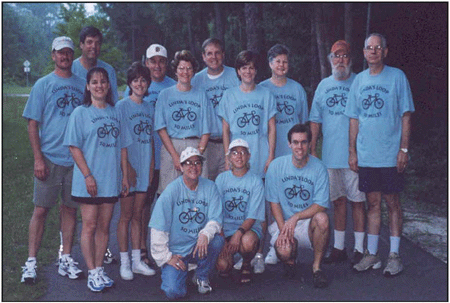
Linda's Loop Participants

Participants in Linda’s Loop:

Left to Right: (Front Row, kneeling) Georgann Pattillo, Jan Rowe, Bill Schilling ; (Middle Row) Kevin Adams, Linda Moore, Liz Adams, Sue Schilling, Brenda Schilling, Betty Lamey, Patrick Pattillo, Leroy Lamey ; (Back Row) Chandler Burroughs, Steven Rowe, and Bill Schilling, Sr.

The night before the ride, we finished packing up drinks, snacks, and lunches and then headed home to get some sleep. Liz told me that she didn’t sleep a wink that night – neither did I! We were too excited.

The day finally arrived and everything went so well. It was such a wonderful day that I simply didn’t want it to end! Our family and friends came out to cheer us along. It felt great to have them there. But wow! The miles were more difficult than I expected. Although three riders finished far ahead, the remaining three of us dragged ourselves over the finish line some time later. We were quite the motley crew!

Hot, sweaty, hungry, but happy!

Response to our effort was overwhelming. My husband Bill teases that this was the only time I actually picked up the mail! Liz and I were moved by all the contributions. Some were from people who don’t know Linda but had read about the ride in the local paper. When we started planning we weren’t sure how much money we could raise. It was wonderful to have received just over $8,600 in contributions to vasculitis research!

Linda told me how much love she felt because of what we did for The Johns Hopkins Vasculitis Center. What more could I have asked of myself? We wanted to show Linda how proud we were of all she accomplished during her difficult treatment. We also wanted to say thank you to The Johns Hopkins Vasculitis Center for the wonderful work they do in caring for their patients everyday.

Hopefully we accomplished both.

All information contained within the Johns Hopkins Vasculitis Center website is intended for educational purposes only. Visitors are encouraged to consult other sources and confirm the information contained within this site. Consumers should never disregard medical advice or delay in seeking it because of something they may have read on this website.

Copyright Information

All information contained within this web site is Copyright © 2012 by The Johns Hopkins University School of Medicine and the Johns Hopkins Vasculitis Center.

All rights are reserved. Requests for use of content contained within this site can be emailed, replies can take a minimum of one business week for reply.

Requests for permission to reprint, reproduce, and distribute documents and related graphics that appear on this website/are hosted on this server may be submitted by fax (410)-550-2072 or e-mail to Wes Linda.

The names of the Johns Hopkins University, the Johns Hopkins University Rheumatology Division, the Johns Hopkins Vasculitis WebSite or its faculty or staff may not be used in publicity or advertising without permission. Exceptions to this include listings on web indexes, search engines, and related systems.

The Johns Hopkins University, The Johns Hopkins University School of Medicine and/or its Division of Rheumatology and faculty and staff of the Johns Hopkins University cannot be held responsible or liable for errors or inaccuracies in transcriptions, translations, or any other type of reproduction, alteration or adulteration of material presented on any page of this web site.

Supplemental Immunoglobulin (IVIG/SCIG)

What is IVIG/SCIG?

Intravenous immunoglobulin (IVIG) is a therapy consisting of pooled antibodies (immunoglobulin) obtained from healthy donors that is given as an infusion by vein. This same therapy can also be given as a subcutaneous injection (SCIG) rather than an intravenous one.

How does it work?

IVIG and SCIG are often used to treat patients with immunodeficiency syndromes, which are genetic or acquired conditions that lead to low immunoglobulin levels. For these patients, IVIG/SCIG provide the protective effect of antibodies that they otherwise lack.

In treating vasculitis, we sometimes encounter the need for IVIG/SCIG due to the use of Rituximab – a drug that targets B cells. In some patients, the long-term use of rituximab may lead to an acquired deficiency of immunoglobulins. By combining IVIG/SCIG with rituximab, we are able to continue to provide patients with the immunosuppressive benefit of rituximab, while compensating for the increased risk of infection by giving IVIG/SCIG.

How is IVIG/SCIG given?

IVIG is often given as a home infusion. SCIG is given as a subcutaneous injection. These treatments are generally given once per month.

Side effects:

These treatments carry a risk of blood clot, renal injury, and headaches. IVIG constitutes a large fluid challenge, and therefore may not be appropriate for patients with heart or kidney failure.

  • « Go to Previous Page
  • Go to page 1
  • Go to page 2
  • Go to page 3
  • Go to page 4
  • Go to page 5
  • Go to page 6
  • Go to Next Page »

Primary Sidebar


donate to the Johns Hopkins Vasculitis Center

All information contained within the Johns Hopkins Vasculitis Center website is intended for educational purposes only. Visitors are encouraged to consult other sources and confirm the information contained within this site. Consumers should never disregard medical advice or delay in seeking it because of something they may have read on this website.

Footer

Johns Hopkins Rheumatology

  • Johns Hopkins Rheumatology
  • Johns Hopkins Arthritis Center
  • Johns Hopkins Lupus Center
  • Johns Hopkins Lyme Disease Research Center
  • Johns Hopkins Myositis Center
  • Johns Hopkins Scleroderma Center
  • Johns Hopkins Sjögren’s Syndrome Center

Connect With Us

  • Facebook
  • Twitter
  • YouTube
U.S. News and World Report Rankings Badge

Johns Hopkins Medicine Johns Hopkins Medicine logo
Language Assistance Available:
  • Español
  • American Sign Language
  • עִברִי
  • אידיש
  • አማርኛ
  • 繁體中文
  • Français
  • Tagalog
  • Русский
  • Português
  • Italiano
  • Tiếng Việt
  • Ɓàsɔ́ɔ̀-wùɖù-po-nyɔ̀
  • Igbo asusu
  • èdè Yorùbá
  • বাংলা
  • 日本語
  • 한국어
  • Kreyòl Ayisyen
  • العربية
  • Deutsch
  • Polski
  • Ελληνικά
  • ગુજરાતી
  • ภาษาไทย
  • اُردُو
  • فارسی
  • हिंदी
  • Deitsch
  • ខ្មែរ
  • မြန်မာ
Contact & Privacy Information
Price Transparency
Notice of Privacy Practices Privacy Statement
Terms & Conditions of Use Non-Discrimination Notice
Manage Cookie Preferences
Copyright © 2025 Johns Hopkins Rheumatology